| Identification | |
| Name: | Barium chloride dihydrate |
| Synonyms: | Bariumchloride, dihydrate (8CI);Barium chloride (BaCl2) hydrate (1:2);Bariumdichloride dihydrate;Barium chloride dehydrate; |
| CAS: | 10326-27-9 |
| EINECS: | 233-788-1 |
| Molecular Formula: | BaCl2.2(H2O) |
| Molecular Weight: | 244.27 |
| InChI: | InChI=1/Ba.2ClH.2H2O/h;2*1H;2*1H2/q+2;;;;/p-2 |
| Molecular Structure: | 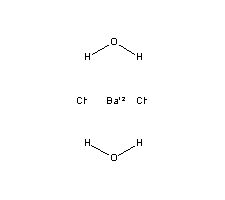 |
| Properties | |
| Transport: | UN 1564 |
| Density: | 3.86 |
| Stability: | Stable. Incompatible with interhalogens, furan-2-percarbonic acid. |
| Water Solubility: | soluble |
| Solubility: | soluble in water |
| Appearance: | White crystalline powder |
| Specification: |
? Barium chloride dihydrate , with CAS number of 10326-27-9, can be called Barium chloride hydrate (1:2:2) ; Dichlorobarium dihydrate . |
| Report: |
Reported in NTP Carcinogenesis studies (drinking); No Evidence: mouse, rat NTPTR* ?? National Toxicology Program Technical Report Series. (Research Triangle Park, NC 27709) No. 206- NTP-TR-432 (1994). . |
| Packinggroup: | III |
| HS Code: | 28273980 |
| Storage Temperature: | Store at RT. |
| Color: | White orthorhombic crystals White solid. |
| Usage: | Used in the purification of brine solution in caustic chlorine plants and also in the manufacture of heat treatment salts, case hardening of steel, and in the manufacture of pigments. |
| Safety Data | |
| Hazard Symbols |
 T:Toxic
|
 |
|