| Identification |
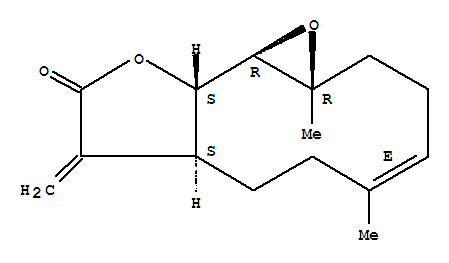
| Name: | Oxireno[9,10]cyclodeca[1,2-b]furan-9(1aH)-one,2,3,6,7,7a,8,10a,10b-octahydro-1a,5-dimethyl-8-methylene-,(1aR,4E,7aS,10aS,10bR)- |
| Synonyms: | Germacra-1(10),11(13)-dien-12-oicacid, 4,5a-epoxy-6b-hydroxy-, g-lactone (8CI);Parthenolide(6CI,7CI);(-)-Parthenolide; |
| CAS: | 20554-84-1 |
| Molecular Formula: | C15H20O3 |
| Molecular Weight: | 248.3175 |
| InChI: | InChI=1S/C15H20O3/c1-9-5-4-8-15(3)13(18-15)12-11(7-6-9)10(2)14(16)17-12/h5,11-13H,2,4,6-8H2,1,3H3/b9-5-/t11-,12-,13-,15+/m0/s1 |
| Molecular Structure: |
 |
| Properties |
| Density: | 1.13 g/cm3 |
| Water Solubility: | Soluble in chloroform, dichlormethane (5 mg/ml-clear, colorless solution), |
| Solubility: | Soluble in chloroform, dichlormethane (5 mg/ml-clear, colorless solution), |
| Appearance: | White to pale yellow crystalline powder |
| Biological Activity: | The active principle of feverfew (Chrysanthemum parthenium), widely used as a herbal remedy for arthritis and migraine and as a febrifuge. Parthenolide is antisecretory, anti-inflammatory, spasmolytic and inhibits the release of 5-HT from blood platelets. Also inhibits generation of leukotriene B 4 and thromboxane B 2 . |
| Safety Data |
| Hazard Symbols |
 Xi: Irritant
|
| |
 |