| Identification |
| Name: | Quinidine |
| Synonyms: | Quinidine free base; (+)-Quindine |
| CAS: | 56-54-2 |
| EINECS: | 200-279-0 |
| Molecular Formula: | C20H24N2O2 |
| Molecular Weight: | 324.42 |
| InChI: | InChI=1/C20H24N2O2/c1-3-13-12-22-9-7-14(13)10-19(22)20(23)16-6-8-21-18-5-4-15(24-2)11-17(16)18/h3-6,8,11,13-14,19-20,23H,1,7,9-10,12H2,2H3/t13-,14?,19+,20-/m0/s1 |
| Molecular Structure: |
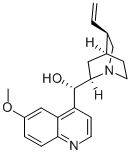 |
| Properties |
| Transport: | UN 2811 |
| Density: | 0.05 g/100 mL (20ºC) |
| Stability: | Stable. Incompatible with strong oxidizing agents. |
| Alpha: | 256 º (C=1, ETOH) |
| Solubility: | 0.05 g/100 mL (20ºC) in water |
| Appearance: | white to light yellow crystal powde |
| Packinggroup: | III |
| Storage Temperature: | Keep containers tightly closed. Store protected from light. Store in a cool, dry area away from incompatible substances. |
| Sensitive: | Light Sensitive |
| Color: | Occurs as fine, needle-like, white crystals which frequently cohere in masses or as a fine, white powder. |
| Usage: | A dextrorotatory stereoisomer of Quinine. Antiarrhythmic (class IA). Antimalarial |
| Safety Data |
| Hazard Symbols |
 Xn:Harmful
|
| |
 |