| Identification | |
| Name: | Ethyl glycolate |
| Synonyms: | Aceticacid, hydroxy-, ethyl ester (9CI);Glycolic acid, ethyl ester (7CI,8CI);2-Hydroxyacetic acid ethyl ester;Ethyl 2-hydroxyacetate;Acetic acid,2-hydroxy-, ethyl ester;Ethyl hydroxyacetate;NSC 8835; |
| CAS: | 623-50-7 |
| EINECS: | 210-798-4 |
| Molecular Formula: | C4H8O3 |
| Molecular Weight: | 104.1 |
| InChI: | InChI=1/C4H8O3/c1-2-7-4(6)3-5/h5H,2-3H2,1H3 |
| Molecular Structure: | 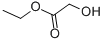 |
| Properties | |
| Transport: | 200kgs |
| Density: | 1.08 |
| Stability: | Stable at room temperature in closed containers under normal storage and handling conditions. |
| Refractive index: | 1.417-1.42 |
| Solubility: | Very soluble |
| Appearance: | clear colorless liquid |
| Specification: |
Ethyl glycolate , its cas register number 623-50-7. It also can be called Ethyl hydroxyacetate ; Hydroxyacetic acid ethyl ester ; and Acetic acid, 2-hydroxy-, ethyl ester . Ethyl glycolate (CAS NO.623-50-7) should avoid the condition like incompatible materials. It is not compatible with strong oxidizing agents, strong bases. And also prevent it to broken down into hazardous decomposition products: carbon monoxide, carbon dioxide. However, its hazardous polymerization has not been reported. |
| Report: |
Reported in EPA TSCA Inventory. |
| Packinggroup: | III |
| Storage Temperature: | Keep container closed when not in use. Store in a cool, dry, well-ventilated area away from incompatible substances. Keep containers tightly closed. |
| Safety Data | |
| Hazard Symbols |
 Xi:Irritant
|
 |
|