| Identification | |
| Name: | Lactose |
| Synonyms: | 4-O-beta-D-Galactopyranosyl-D-glucose;D-Glucose, 4-O-beta-D-galactopyranosyl-;Galactinum;Fast-flo Lactose; |
| CAS: | 63-42-3 |
| EINECS: | 200-559-2 |
| Molecular Formula: | C12H22O11 |
| Molecular Weight: | 342.34 |
| InChI: | InChI=1S/C12H22O11/c13-1-3-5(15)6(16)9(19)12(22-3)23-10-4(2-14)21-11(20)8(18)7(10)17/h3-20H,1-2H2/t3-,4-,5+,6+,7-,8-,9-,10-,11-,12+/m1/s1 |
| Molecular Structure: | 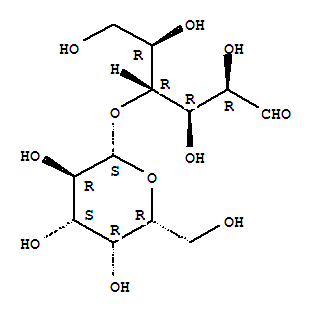 |
| Properties | |
| Density: | 1.76 g/cm3 |
| Stability: | Stable. Incompatible with strong oxidizing agents. |
| Water Solubility: | 5-10 G/100 ML AT 20 oC |
| Solubility: | 5-10 g/100 mL at 20 ºC in water |
| Appearance: | white crystals or powder |
| Specification: |
Lactose is a sugar that is found most notably in milk. The name comes from the Latin word for milk, plus the -ose ending used to name sugars. |
| Report: |
Reported in EPA TSCA Inventory. |
| Storage Temperature: | Store in a cool, dry place. Keep container closed when not in use. |
| Usage: | Both forms of lactose are employed, with the form predominating: as a nutrient in preparing modified milk and food for infants and convalescents (whittier). |
| Safety Data | |
 |
|