| Identification | |
| Name: | Thiophene,2,5-dihydro-, 1,1-dioxide |
| Synonyms: | 2,5-Dihydrothiophen-1,1-dioxide;2,5-Dihydrothiophene 1,1-dioxide; 2,5-Dihydrothiophene S,S-dioxide;2,5-Dihydrothiophene dioxide; 2,5-Dihydrothiophene sulfone; 3-Sulfolene;Butadiene sulfone; NSC 48532; NSC 56373; Sulfolene; Sulpholene; b-Sulfolene |
| CAS: | 77-79-2 |
| EINECS: | 201-059-7 |
| Molecular Formula: | C4H6 O2 S |
| Molecular Weight: | 118.15 |
| InChI: | InChI=1/C4H6O2S/c5-7(6)3-1-2-4-7/h1-2H,3-4H2 |
| Molecular Structure: | 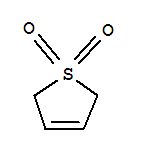 |
| Properties | |
| Transport: | 25kgs |
| Melting Point: | 65 - 66 C |
| Flash Point: | 112 C |
| Boiling Point: | Decomposes |
| Density: | 1.3 |
| Stability: | Stable, but decomposes above the melting point. Combustible. Incompatible with strong oxidizing agents. |
| Water Solubility: | Soluble |
| Solubility: | Soluble |
| Appearance: | white crystals |
| Specification: |
2,5-Dihydrothiophene Dioxide (CAS NO.77-79-2) is a white crystalline solid. |
| Report: |
NCI Carcinogenesis Bioassay (gavage); No Evidence: mouse, rat NCITR* National Cancer Institute Carcinogenesis Technical Report Series. (Bethesda, MD 20014) No. NCI-CG-TR-102 ,1978. . Reported in EPA TSCA Inventory. |
| Flash Point: | 112 C |
| Color: | CRYSTALS |
| Safety Data | |
| Hazard Symbols | |
 |
|