| Identification | |
| Name: | Citric acid |
| Synonyms: | 2-Hydroxy-1,2,3-propanetricarboxylic acid; Citric acid, anhydrous, USP Grade 1,2,3-Propanetricarboxylic acid, 2 hydroxy-citric acid, anhydrous, USP Grade; Citric acid anhydrous; Citric acid anhydride |
| CAS: | 77-92-9 |
| EINECS: | 201-069-1 |
| Molecular Formula: | C6H8O7 |
| Molecular Weight: | 192.12 |
| InChI: | InChI=1/C6H8O7/c7-3(8)1-6(13,5(11)12)2-4(9)10/h13H,1-2H2,(H,7,8)(H,9,10)(H,11,12) |
| Molecular Structure: | 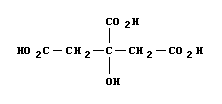 |
| Properties | |
| Transport: | UN 1789 8/PG 3 |
| Density: | 1.542g/cm3 |
| Stability: | Stable. Incompatible with bases, strong oxidizing agents, reducing agents, metal nitrates. |
| Refractive index: | 1.493~1.509 |
| Appearance: | White crystalline powder |
| Specification: |
Citric Acid Anhydrous (CAS NO: 77-92-9) is also called Citric acid anhydrous ; 2-Hydroxy-1,2,3-propanetricarboxylic acid ; 2-Hydroxytricarballylic acid . |
| Biological Activity: | Commonly used laboratory reagent |
| Storage Temperature: | Store at RT. |
| Sensitive: | Hygroscopic |
| Color: | Crystals; monoclinic holohedra; crystallizes from hot concentrated aqueous solution Colorless, translucent crystals or powder Rhombic crystals from water with 1 mol of water of crystallization |
| Safety Data | |
| Hazard Symbols |
 Xi:Irritant
|
 |
|