| Identification | |
| Name: | Potassium citrate |
| Synonyms: | 1,2,3-Propanetricarboxylicacid, 2-hydroxy-, tripotassium salt (9CI);Citric acid, tripotassium salt(8CI);Kajos;Kaliksir;Litocit;Polycitra K;Porekal;Potassium tribasic citrate;Seltz-K;Tripotassium citrate;Urocit K; |
| CAS: | 866-84-2 |
| EINECS: | 212-755-5 |
| Molecular Formula: | C6H5K3O7 |
| Molecular Weight: | 324.42 |
| InChI: | InChI=1S/C6H8O7.3K/c7-3(8)1-6(13,5(11)12)2-4(9)10;;;/h13H,1-2H2,(H,7,8)(H,9,10)(H,11,12);;;/q;3*+1/p-3 |
| Molecular Structure: | 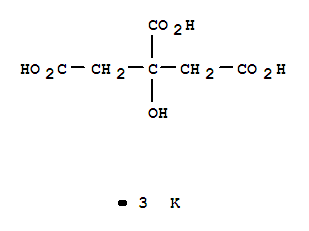 |
| Properties | |
| Transport: | 25kgs |
| Density: | 1.187g/cm3 |
| Stability: | Stable at normal temperatures and pressures. |
| Solubility: | 1.5 kg/L |
| Appearance: | white crystalline powder |
| Specification: |
? Potassium citrate , with CAS number of 866-84-2, can be called 1,2,3-Propanetricarboxylic acid, 2-hydroxy-, tripotassium |
| Report: |
?Potassium citrate (CAS NO.866-84-2) is reported in EPA TSCA Inventory. |
| Storage Temperature: | Store in a cool, dry location in a tightly closed container. Protect from physical damage. |
| Color: | WHITE CRYSTALS, GRANULES, OR POWDER TRANSPARENT CRYSTALS |
| Usage: | Medication. |
| Safety Data | |
 |
|