| Identification | |
| Name: | Pimelic acid |
| Synonyms: | Pimelicacid (8CI);1,5-Pentanedicarboxylic acid;1,7-Heptanedioic acid;NSC 30112;Pileric acid;Heptanedioic Acid; |
| CAS: | 111-16-0 |
| EINECS: | 203-840-8 |
| Molecular Formula: | C7H12O4 |
| Molecular Weight: | 160.17 |
| InChI: | InChI=1/C7H12O4/c8-6(9)4-2-1-3-5-7(10)11/h1-5H2,(H,8,9)(H,10,11) |
| Molecular Structure: | 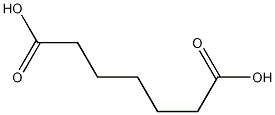 |
| Properties | |
| Density: | 1.29 |
| Stability: | Stable. Incompatible with oxidizing agents, bases. Combustible. |
| Solubility: | ethanol: 0.1 g/mL, clear to very faintly hazy |
| Appearance: | white crystal or crystal powder; |
| Specification: |
Pimelic acid (CAS NO.111-16-0) is one methylene longer than a related dicarboxylic acid, adipic acid, a precursor to many polyesters and polyamides. It has some synonyms like 1,5-Pentanedicarboxylic acid ; Heptanedioic acid ; Pentane-1,5-dicarboxylic acid ; Heptanedioic-2,2,6,6-d4 acid (Pimelic acid) ; 6-Carboxyhexanoate ,and so on. |
| Report: |
Reported in EPA TSCA Inventory. |
| HS Code: | 29171990 |
| Storage Temperature: | Store in a tightly closed container. Store in a cool, dry, well-ventilated area away from incompatible substances. |
| Usage: | Involved in the biosynthesis of the lysine. . |
| Safety Data | |
| Hazard Symbols |
 Xi:Irritant
|
 |
|