| Identification | |
| Name: | Stannous chloride |
| Synonyms: | Stannouschloride dihydrate;Stannous dichloride dihydrate;Tin chloride dihydrate;Tindichloride dihydrate;Tin(II) chloridedihydrate; |
| CAS: | 10025-69-1 |
| EINECS: | 231-868-0 |
| Molecular Formula: | Cl2H4O2Sn |
| Molecular Weight: | 225.63 |
| InChI: | InChI=1/2ClH.2H2O.Sn/h2*1H;2*1H2;/q;;;;+2/p-2 |
| Molecular Structure: | 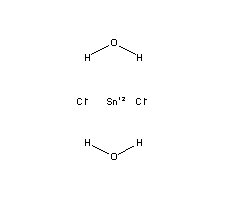 |
| Properties | |
| Transport: | UN 1759/3260 |
| Density: | 2.71 |
| Stability: | Stable. Incompatible with strong oxidizing agents, alkali metals, ammonia, alcohols, alkalies, nitrates, boron trifluoride, boron trichloride, carbides. |
| Appearance: | colorless to white, odorless solid |
| Specification: |
Stannous chloride , its cas register number is 10025-69-1. It also can be called Stannochlor ; Stannous chloride dihydrate ; Stannous dichloride dihydrate ; TIN Chloride, dihydrate ; Dihydrated stannous chloride .It is a colorless to white, odorless solid.. |
| Packinggroup: | II |
| HS Code: | 28273910 |
| Storage Temperature: | Store at RT. |
| Sensitive: | Air Sensitive |
| Color: | White, ortho rhombic crystals Orthorhombic crystalline mass or flakes; fatty appearance |
| Usage: | Widely used as a reducing agent (in acid solution), and in electrolytic baths for tin-plating. |
| Safety Data | |
| Hazard Symbols |
 C:Corrosive
|
 |
|